
Healthcare-Specific OSHA HazCom Training to Understand Chemical Hazards, Labels, SDSs, and Safe Work Practices
Healthcare professionals work with many products that can create chemical hazards, including disinfectants, sterilants, cleaning agents, laboratory chemicals, dental materials, solvents, compressed gases, and specialty healthcare products. Understanding these hazards is essential to protecting employees who handle or may be exposed to hazardous chemicals during their daily work.
The OSHA Hazard Communication Standard (HazCom) requires employers to provide employees with information and training about workplace chemical hazards. This online OSHA HazCom and GHS Training for Medical, Dental, and Healthcare Professionals helps employees understand chemical labels, GHS pictograms, Safety Data Sheets (SDS), hazard classifications, chemical controls, PPE requirements, and safe response procedures.
This course is designed specifically for healthcare environments, including hospitals, clinics, dental offices, laboratories, pharmacies, surgery centers, long-term care facilities, instrument-processing areas, environmental services, and other healthcare support operations.
About This OSHA HazCom and GHS Course
The purpose of Hazard Communication training is to ensure employees can recognize chemical hazards before exposure occurs and understand how to protect themselves.
This course focuses on the decisions healthcare workers make during real workplace situations:
- Recognizing chemical hazards before use
- Understanding OSHA HazCom requirements
- Reading chemical labels and warning information
- Understanding GHS pictograms and hazard symbols
- Using Safety Data Sheets (SDS)
- Selecting appropriate chemical controls and PPE
- Responding safely to chemical spills and exposures
Employees are not expected to classify chemicals like manufacturers. Instead, they need to understand the hazard information provided, follow workplace procedures, and know when to stop work and seek assistance.
Who Should Take This Training?
This OSHA HazCom course is designed for healthcare workers who use hazardous chemicals or may encounter chemical hazards during normal work activities or foreseeable emergencies.
Medical and Clinical Professionals
Recommended for:
- Physicians and providers
- Nurses
- Medical assistants
- Clinical staff
- Surgery center employees
- Hospital employees
- Long-term care workers
Dental Professionals
Recommended for:
- Dentists
- Dental hygienists
- Dental assistants
- Dental office employees
- Dental laboratory personnel
- Instrument-processing staff
Laboratory and Diagnostic Professionals
Recommended for:
- Laboratory technicians
- Diagnostic laboratory employees
- Research personnel
- Pharmacy employees
- Imaging department staff
Healthcare Support Personnel
Recommended for:
- Environmental services employees
- Facilities teams
- Supply and receiving personnel
- Sterile processing employees
- Waste management personnel
HazCom applies to employees who use hazardous chemicals or may be exposed during routine work or foreseeable emergencies.
What You Will Learn in This OSHA HazCom Training Course
After completing this course, learners will understand:
OSHA Hazard Communication Standard
- The purpose of OSHA HazCom
- Employer and employee responsibilities
- Written HazCom programs
- Chemical inventories
- Workplace-specific training requirements
Globally Harmonized System (GHS)
- How GHS supports chemical hazard communication
- Hazard classes and categories
- Chemical labels and pictograms
- Signal words and hazard statements
Chemical Hazard Recognition
Learn how to identify:
- Physical hazards
- Health hazards
- Chemical exposure routes
- Fire and pressure hazards
- Corrosive chemicals
- Toxic substances
- Long-term health hazards
Chemical Labels and Pictograms
Understand:
- Product identifiers
- Signal words such as Danger and Warning
- Hazard statements
- Precautionary statements
- OSHA-required pictograms
Safety Data Sheets (SDS)
Learn how to locate and use important SDS sections, including:
- Hazard identification
- First-aid measures
- Spill response
- Handling and storage
- Exposure controls
- Personal protective equipment requirements
The SDS provides detailed chemical safety information while labels provide the first warning employees see before using a product.
Healthcare Chemical Hazards Covered in This Course
Healthcare workplaces use many products that require hazard awareness.
Examples include:
- Surface disinfectants and cleaners
- Sterilization chemicals
- Instrument-processing chemicals
- Dental etchants and adhesives
- Laboratory reagents
- Fixatives and solvents
- Compressed gases
- Hazardous drug-related products
Employees should understand that a product used for patient care can still create occupational exposure risks for healthcare workers.
OSHA HCS 2024 Update Training Included
This course includes updates related to the OSHA Hazard Communication Standard 2024 update.
Topics include:
- Updated hazard classification requirements
- Changes affecting labels and SDS information
- Small container labeling updates
- Revised physical hazard categories
- Updated employee training considerations
The HCS 2024 update improves hazard communication by increasing clarity and consistency of chemical hazard information.
Why Healthcare Professionals Need HazCom Training
Healthcare employees often work with chemicals that may:
- Irritate skin, eyes, or respiratory systems
- Cause chemical burns
- Create fire risks
- Require specialized PPE
- Require specific storage and handling procedures
Common mistakes that increase exposure risks include:
- Using unlabeled containers
- Assuming a familiar chemical is safe
- Mixing chemicals without training
- Using incorrect gloves or PPE
- Ignoring SDS information
- Cleaning spills without proper authorization
This course teaches employees how to recognize warning signs and follow safer workplace practices.
Course Modules
Module 1: HazCom and GHS Basics
Learn:
- Purpose of OSHA HazCom
- Relationship between OSHA and GHS
- HCS 2024 updates
- Employer and employee responsibilities
Module 2: Chemical Hazards
Learn:
- Physical hazards
- Health hazards
- Exposure routes
- Chemical hazard categories
- Healthcare examples
Module 3: Chemical Labels and GHS Pictograms
Learn:
- Required label elements
- Signal words
- Hazard statements
- Precautionary statements
- OSHA pictograms
Module 4: Safety Data Sheets (SDS)
Learn:
- SDS sections
- Finding hazard information
- Selecting PPE
- Responding to chemical incidents
Module 5: Chemical Controls and Response
Learn:
- Engineering controls
- Safe work practices
- Chemical PPE
- Spill and exposure response
Course Features
✓ 100% Online Training
✓ Self-Paced Learning
✓ Healthcare-Specific Examples
✓ Medical and Dental Workplace Focus
✓ Covers OSHA HazCom and GHS Concepts
✓ Includes HCS 2024 Updates
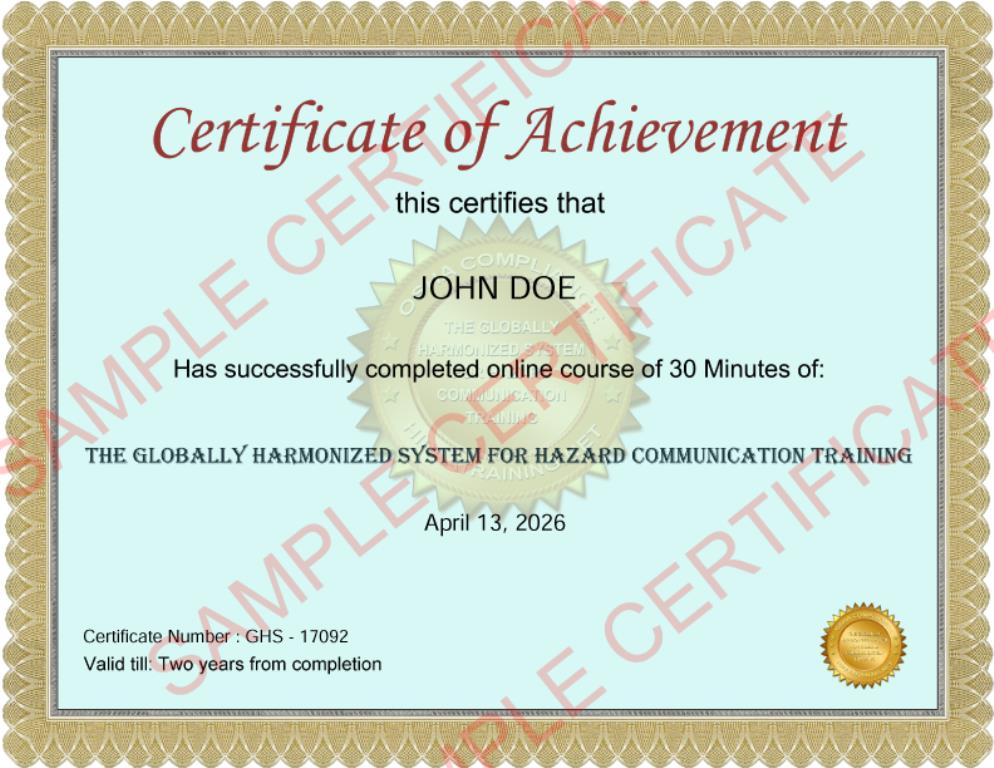
✓ Certificate of Completion Provided
Certificate for Continuing Education Credits:
Students can buy a CE credits certificate for this course at the time of registration. You will receive one CE credit for this course through the Approved Provider of California Board of Registered Nursing after completing the course.
Please contact us for more information at Bob@hipaatraining.net or call (515) 865-4591.
Frequently Asked Questions
Enroll in OSHA HazCom and GHS Training for Healthcare Professionals
Protect yourself and your team by learning how to recognize chemical hazards, understand warning labels, use Safety Data Sheets, and follow safer chemical handling practices.
Start your OSHA Hazard Communication and GHS Training today.
Testimonials
- It is extremely beneficial in learning all of the types of hazards and how to handle them.
Steven Yount - Very great class. Informative and the platform is user friendly.
Brooke Keith - Great course. very precise and clear in information
Kelvin Jones - Useful information for safety workplace
TAMAR KHZAALI - This was a great course that discussed relevant material
Saba Saleem - This program was very helpful and informative
Rebecca Lynn Wright - Very helpful and easy to understand!
Nahiyan khandker - Great course! Definitely helpful!
Kryn Bleeker
USER RATING:
The Globally Harmonized System (GHS) for Hazard Communication Training is rated 4.8 out of 5 by 365 users.